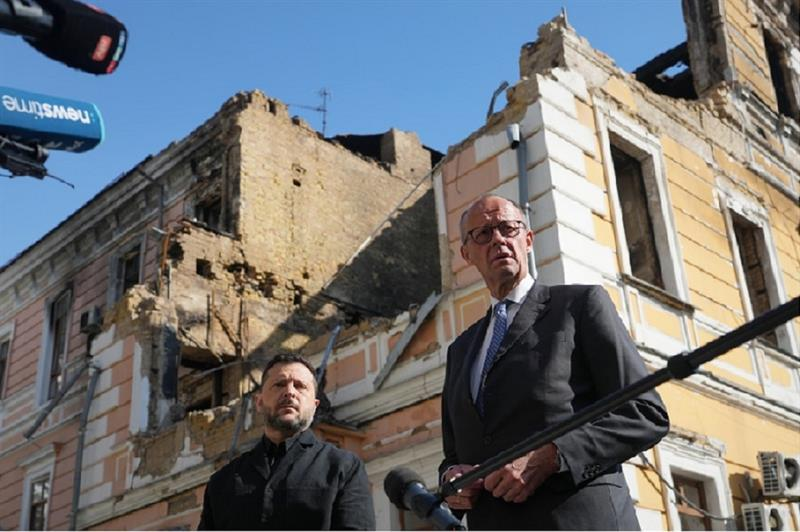
German Chancellor Friedrich Merz flew to Kyiv on October 4, 2026 for a surprise solidarity visit at a moment when Russia has stepped up drone and missile strikes on Ukrainian cities. Speaking alongside President Volodymyr Zelenskiy amid repeated air raid sirens, Merz announced a package of measures that Berlin says will bolster Ukraine’s air defences, repair critical infrastructure ahead of winter, and expand German-Ukrainian defence industrial cooperation.
What Berlin announced
At a joint press appearance, Merz confirmed that Germany would make an immediate contribution of roughly €1 billion in military aid and an additional €350 million targeted at repairs in the energy sector. German officials travelling with the chancellor also said executives from German defence and technology companies had signed a series of commercial and cooperation agreements with Ukrainian partners, collectively valued at about €6.6 billion.
Government briefings and reporting by international news agencies say the military component will fund interceptor drones, air defence munitions and related systems, while the energy funding is intended to repair damage to grids and heating infrastructure that has accumulated in recent months as Russian strikes increasingly target civilian utilities.
Industry deals and technology cooperation
Officials highlighted a cluster of contracts with established German suppliers. Among the agreements reported by government and press accounts were commitments involving German defence firms for radar and missile systems, and arrangements to jointly produce or supply jet drone interceptors. Names of companies cited in media reports included established defence suppliers and specialist drone manufacturers, with a focus on systems designed to counter the faster, jet propelled attack drones that Ukraine has struggled to defeat with legacy air defences.
Berlin framed these industry ties as both strategic assistance to Ukraine and as jobs and technology cooperation for Germany. The chancellor and Ukrainian leaders characterised the arrangements as two way, with Ukrainian operational experience and German industrial capacity mutually reinforcing allied capabilities.
Security backdrop and Kyiv’s immediate needs
The trip took place as Kyiv has faced a sustained wave of high speed drone and missile strikes in recent weeks. Reporters and footage from the city showed air raid sirens and at least one strike that damaged a major bridge across the Dnipro river, underscoring the campaign’s focus on transport and energy infrastructure. Ukrainian authorities have warned that winter looms as a period of particular vulnerability for civilian populations if power and heating systems are left damaged.
Merz underscored the security rationale for Germany’s support, saying that backing Ukraine is not an act of charity but a contribution to European security. He warned that hybrid operations including strikes, cyber-attacks and disinformation threaten democratic stability across the continent, and he appealed for continued international pressure to push for an end to the fighting.
Why the visit matters for Germany and Europe
The chancellor’s visit is significant on three fronts. First, it signals that Germany is prepared to deepen military assistance at a time of rising Russian strikes on civilian targets, closing political distance between Berlin and Kyiv over the scale and urgency of support. Second, by attaching industrial cooperation and procurement with German firms to the aid package, the trip links security assistance to domestic economic interests and supply chain resilience. Third, the visit is a public demonstration of Berlin’s willingness to accept the political risks of tougher posture toward Moscow at a moment when hybrid threats are visible inside and beyond Ukraine.
Domestically, the German government has faced public debate about the costs and limits of supplying weapons overseas, and about the pace of rearming and replenishing national stocks. The chancellor acknowledged those debates in his remarks but framed the steps announced in Kyiv as investments in the shared security of Europe.
Regional and diplomatic ripple effects
Allied capitals will be watching whether Berlin’s package prompts similar moves from other European states and how quickly promised deliveries can be realised. The agreements with German companies could also accelerate local production in Ukraine, a diplomatic aim repeatedly stated by Kyiv to reduce reliance on external supply lines and to rebuild industrial capacity inside the country.
The trip also comes against the backdrop of diplomatic signals about possible new technical-level talks. Ukrainian officials and several Western partners have indicated interest in meetings aimed at exploring avenues toward deescalation, even as military operations continue. Merz stressed that while Germany supports a negotiated end to the conflict if Russia is willing, it will not tolerate attacks on civilians or infrastructure as a bargaining lever.
What to watch next
Key near term indicators include how quickly pledged military systems reach Ukrainian forces, the timelines for energy repairs funded by the new package, and progress in converting commercial agreements into functioning industrial projects inside Ukraine. Observers will also monitor Moscow’s diplomatic and military response, and whether the increased European support changes the tempo or targets of the Russian campaign.
For Berlin, the practical test will be execution: turning announcements and contracts into delivered equipment and repaired infrastructure during a winter season that many analysts regard as likely to be the most consequential period yet for Ukraine’s civilian resilience.