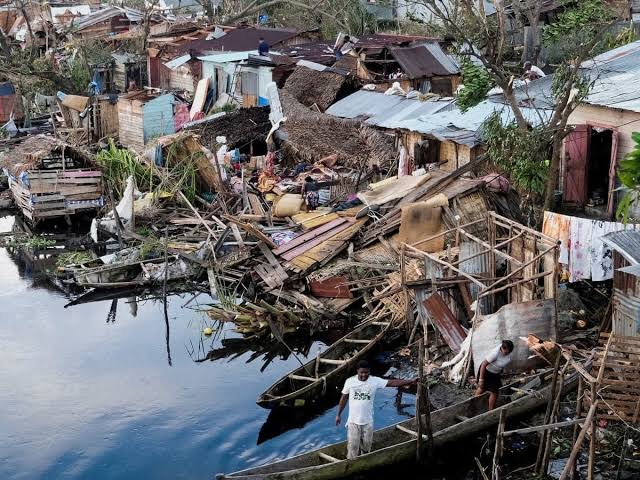
New AI System Could Give Forecasters an Extra Day to Track Dangerous Cyclones
Artificial intelligence is beginning to tackle one of weather science's hardest challenges: predicting not only where a tropical cyclone will travel, but how powerful and large it could become.
Researchers have developed an AI-based forecasting system called WeatherNext Cyclones, designed specifically to predict the track, intensity and size of tropical cyclones as far as 15 days into the future.
The research appears in the September 17 issue of Nature.
When researchers tested the system using cyclones that occurred between 2023 and 2025, its forecasts provided about one additional day of useful lead time on average compared with leading operational forecasting models.
That may sound like a modest improvement.
For communities preparing for a major hurricane or typhoon, however, another day can be extremely valuable.
Why Cyclones Are So Difficult to Predict
Modern weather forecasting has improved enormously, particularly when predicting the path a storm is likely to follow.
Intensity remains much harder.
A cyclone can strengthen rapidly when it encounters favourable ocean and atmospheric conditions. In some cases, a storm can become significantly more dangerous over a relatively short period.
Forecasters therefore need to answer several questions simultaneously.
Where will the cyclone go?
How strong will its winds become?
How large will the storm grow?
And how might all of those characteristics change before it reaches populated areas?
Small forecasting errors can have major consequences when millions of people potentially lie in a storm's path.
AI Is Learning From the Atmosphere Differently
Traditional weather prediction relies heavily on numerical models that use physics to calculate how atmospheric conditions will evolve.
Those systems remain enormously important.
AI-based forecasting introduces another approach.
Machine-learning systems can study vast quantities of historical atmospheric information and learn patterns connecting current conditions with what happens later.
WeatherNext Cyclones is particularly interesting because its intensity forecasts were produced from atmospheric information that is substantially coarser than the data used by specialised regional forecasting models.
Researchers found that the system could still produce strong intensity predictions.
That suggests large-scale atmospheric structures may contain more information about future cyclone strength than scientists previously recognised.
One More Day Can Matter
Forecast lead time has practical consequences.
Emergency authorities need time to decide whether evacuations are necessary. Hospitals may need to prepare for interruptions. Airlines alter routes. Ports secure equipment and vessels. Utility companies position repair crews.
Families also need time to make decisions.
An additional day of reliable information could allow people to obtain supplies, protect property or leave vulnerable areas before roads become congested.
It does not mean that every forecast becomes certain 15 days in advance.
Weather remains chaotic, and uncertainty generally increases the further scientists try to predict into the future.
The value lies in improving the quality and usefulness of the information available at each stage.
AI Is Not Replacing Weather Scientists
The arrival of artificial intelligence in meteorology does not mean human forecasters are disappearing.
Quite the opposite.
AI systems produce predictions, but meteorologists still need to interpret them alongside satellite observations, radar, ocean measurements and conventional numerical models.
Forecasters also communicate uncertainty.
That role becomes particularly important during dangerous weather events because people may interpret a forecast as a guarantee rather than a probability.
An AI system might identify several possible storm paths with different levels of confidence. Human experts still need to determine how that information should be communicated to emergency agencies and the public.
The most useful future may therefore combine multiple approaches rather than replacing one with another.
Already Moving Beyond the Laboratory
WeatherNext Cyclones is notable because the technology is not being discussed solely as a research experiment.
According to Nature, its predictions are now providing guidance to forecasters at the US National Hurricane Center and other agencies around the world.
That transition matters.
Many impressive AI research projects perform well under controlled testing but face additional challenges when introduced into real operational environments.
Weather forecasting is especially demanding because incorrect information can influence high-stakes public decisions.
Real-world use therefore provides an important test of whether AI forecasting improvements can translate into better decisions.
Climate Risk Makes Better Forecasting More Valuable
Tropical cyclones already rank among the world's most destructive natural hazards.
Their impact can include extreme winds, flooding, storm surge, landslides and widespread infrastructure damage.
Coastal populations and infrastructure are also expanding in many vulnerable regions.
At the same time, scientists are studying how a warming climate may influence cyclone rainfall, intensity and other characteristics.
Better forecasting cannot prevent a cyclone from forming.
It can, however, reduce uncertainty about what the storm may do next.
That distinction is important.
The purpose of a better forecast is not simply scientific accuracy. It is to give societies more useful time to respond.
AI Weather Forecasting Is Advancing Quickly
Weather prediction has become one of the most promising scientific applications of modern artificial intelligence.
Researchers have increasingly demonstrated that machine-learning systems can produce global forecasts much faster than traditional numerical simulations for some tasks.
The next challenge is making those systems more specialised and useful.
Cyclones provide an ideal test because predicting them requires understanding several interconnected characteristics rather than merely forecasting temperature or rainfall at a particular location.
A system capable of improving storm track, intensity and size predictions simultaneously could therefore represent an important advance.
What Scientists Still Need to Learn
AI forecasting is not free from limitations.
Machine-learning systems learn from existing information. Extremely unusual events may therefore present difficulties if similar atmospheric patterns are poorly represented in their training data.
Researchers must also understand why a system produces a particular prediction.
That becomes particularly important when an AI forecast disagrees sharply with conventional models.
Scientists need ways to determine whether the AI has detected an important atmospheric signal or simply made an error.
This is why continued testing across many storm seasons will matter.
Performance during historical cyclones provides strong evidence, but operational forecasting will reveal how the technology handles future events that researchers have never seen before.
A Different Kind of AI Revolution
Much of the public conversation around artificial intelligence focuses on chatbots, images and workplace automation.
Scientific AI may ultimately have equally important consequences.
Systems capable of identifying patterns in enormous datasets are being applied to biology, medicine, materials science, astronomy and climate research.
Weather forecasting is particularly tangible because almost everyone is affected by the atmosphere.
A better forecast can change a real-world decision within hours.
WeatherNext Cyclones demonstrates what that scientific side of the AI revolution can look like: not a machine replacing a scientist, but a new computational tool helping experts see dangerous events earlier.
If its performance continues to hold up in operational use, an extra day of cyclone warning could become much more than an impressive forecasting statistic.
For communities facing an approaching storm, it could become extra time to prepare.