After U.S. summit, China secures tariff relief and an AI incidents channel as leaders pledge continued cooperation
Following President Xi Jinping’s state visit to Washington, Beijing announced a reciprocal tariff reduction worth about $30 billion and the establishment of an AI incidents channel with the United States. The measures widen short term economic relief for exporters and embed new avenues for technology diplomacy, but they raise questions about strategic competition and domestic political framing in China.
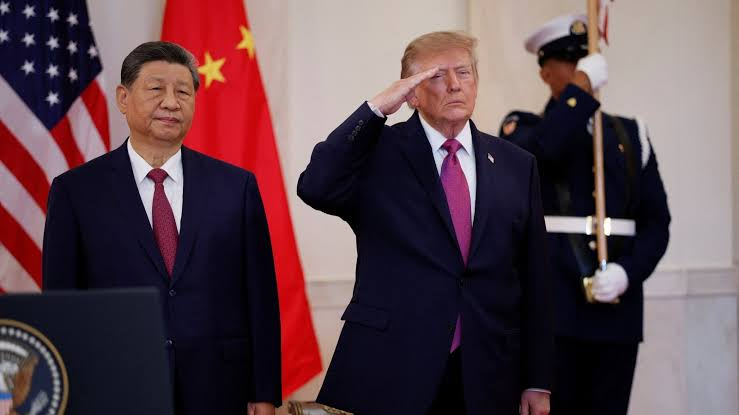
Beijing announced on September 27, 2026 that China and the United States had concluded an eight point set of understandings after President Xi Jinping’s three day state visit to Washington. The central items Beijing highlighted were a reciprocal tariff reduction package valued at roughly $30 billion and a commitment by the two governments to establish a formal channel to manage artificial intelligence incidents and to hold regular AI policy dialogues. The agreements were presented by Chinese officials as a pragmatic, reciprocal step designed to reduce trade frictions that have burdened manufacturing and agricultural exporters, and to create a formal route to deescalate technological incidents that could otherwise spiral into larger confrontations. State statements emphasized mutual support for each other’s hosting of major multilateral meetings later this year, and said both sides would keep working on unresolved trade and technology issues. H2: What Beijing says it won Chinese official statements described the tariff reductions as a concrete outcome that will benefit exporters in both countries. Chinese state media and the foreign ministry framed the move as a sign that personal diplomacy between the two heads of state can yield tangible, measurable results for producers and consumers on both sides. On artificial intelligence, Beijing highlighted two linked outcomes. First, the two governments agreed to set up a communication channel intended to allow government officials to share information quickly about AI related incidents. Second, officials agreed to launch a regular dialogue on AI risks and governance, with a follow up round scheduled for November. Chinese messaging presented both measures as steps toward managing shared risks while preserving space for technological development. H2: How analysts read Beijing’s gains Analysts cautioned that the tariff package, while headline grabbing, is modest compared with the scale of China U.S. bilateral trade. A reciprocal reduction of $30 billion in tariffs offers immediate relief to certain sectors, but it does not eliminate structural sources of economic tension, such as export controls on key technologies and long running disputes over industrial policy. Experts also noted that tariff reductions of this size can be implemented relatively quickly, which makes them useful as near term confidence building measures, but not a substitute for deeper negotiated settlements on trade and technology rules. On AI, the new incident channel represents an unusual attempt to routinize crisis communications around a technology where missteps can be instantaneous and consequential. Observers said the practical value of such a channel will depend on the substance of working rules, the speed of exchanges, and whether the channel is accompanied by technical cooperation on safety research, independent audits, or shared incident taxonomies. H2: Domestic and geopolitical stakes for China For the Chinese leadership, the summit outcomes serve several purposes. Economically, tariff relief gives exporters a short term boost ahead of the winter ordering season and helps shore up employment in export oriented provinces. Politically, a visible economic payoff from summit diplomacy bolsters a narrative of responsible statecraft that prioritizes national development and stability. Strategically, Beijing has sought to balance competition with managed cooperation, preserving room to advance national technology goals while avoiding a costly clash with Washington. The AI channel and tariff steps create instruments for that balancing act, but they also leave sensitive vectors unresolved, in particular U.S. export controls on advanced semiconductors and restrictions on certain software and equipment. H2: Regional reactions and Taiwan implications Neighbors and trade partners are likely to follow the outcome closely. Taipei reacted cautiously in the immediate hours after the summit, noting concerns about security and defense needs in light of changes to U.S. policy flows. Analysts said any U.S. movement that eases economic friction with Beijing will be scrutinized for its implications on deterrence and regional balance, especially because tariff and trade measures sit alongside broader security consultations and arms sale considerations. H2: The limits of personalization in diplomacy Commentators underscored that much of the summit reflected personalized diplomacy between two heads of state, which can produce quick, headline outcomes. That strength is also a weakness, because agreements framed around leader level understandings require follow through by bureaucracies on both sides. Implementation questions remain: which specific tariff lines will be cut, when exclusions or phase outs take effect, what technical standards will undergird the AI exchanges, and how disagreements will be managed if incidents occur. Beijing’s initial publications and statements on September 27 framed the results as pragmatic and reciprocal steps that protect national development interests while reducing bilateral tensions. How those steps will reshape China’s technology trajectory and its longer term economic relationship with the United States will depend on detailed implementation, verification, and whether the two sides can convert summit moments into durable, institutionally backed cooperation. The coming weeks will be decisive for turning broad understandings into operational agreements, as ministries and trade negotiators in Beijing and Washington begin to stitch details into memoranda, tariff schedules, and technical working groups. For now, the agreements represent a pause in escalation and a test of whether competition and cooperation can be managed simultaneously between the two largest economies in the world.
Topics
LocationBeijing